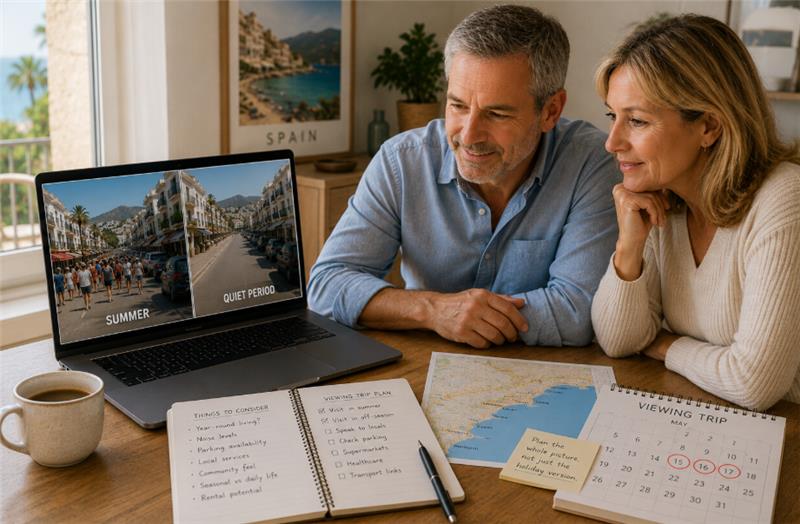
The area looked right during the viewing trip because the conditions supported the visit. Restaurants were open, streets were active, taxis were available, and the route from the airport felt manageable. The property itself may have been bright, well presented, and close to the places you used during the stay. The problem appears when the buyer starts treating a successful visit as proof that the area supports ordinary life throughout the year.
A week in July does not test a January morning, a medical appointment, a school run, a late arrival, a supermarket trip without a car, or building work in the surrounding streets.
A successful viewing does not prove that the area supports ordinary life.
This can produce a home that works well for short stays but creates practical friction during longer periods. The solution is to separate the viewing experience from the living test. Keep the property on the shortlist, but return to the area at a different time of day or season, map essential services, and check how the location functions when leisure is not the main purpose.
This happens because appearance is easier to compare than daily use. Buyers can rank views, terraces, finishes, and distance from the beach within minutes. It takes more effort to compare parking after 20:00, public transport frequency, road noise, winter activity, healthcare access, delivery limitations, stairs, humidity, and the time required to reach an airport outside peak hours. Family members may also assign different value to the same area. One person sees peace and privacy. Another sees isolation and dependence on a car. One sees an old town with character. Another sees access restrictions, noise, and difficult luggage movement.
Location indecision often comes from comparing preferences without agreeing on the daily tasks the area must support.
The solution is to write a location use plan before the next trip. List the weekly routines that matter, the maximum acceptable travel time to essential services, the need for a car, and the periods of the year when the property will be occupied.
This converts broad opinions into practical criteria that can be tested.
The area decision becomes more complex when rental income forms part of the budget. Buyers may rely on an agent’s general comment that a coastal or city property has strong letting potential without confirming the rules attached to that specific home. Since 1 July 2025, a unique rental registration number has been required for marketing short term accommodation through online platforms in Spain. The registration process sits alongside any regional, municipal, community, and property specific requirements that may apply. Demand does not create permission.
A busy visitor area may have restrictions, licence limits, community rules, or property conditions that prevent the intended use. Community statutes and internal rules also need review, especially where the purchase relies on frequent guest turnover. The solution is to make rental use a legal question before it becomes a financial assumption.
Ask the lawyer to confirm the current rules for the municipality, autonomous community, building, and property. Request evidence of any existing licence or registration, and do not value projected income until the right to operate has been checked.
The wrong location can also change the real cost of ownership. A lower purchase price outside the preferred centre may introduce a second car, longer airport transfers, private transport, property management, security visits, garden care, pool maintenance, or higher delivery and repair costs. A central apartment may remove some transport costs but add community fees, parking rental, lift works, façade repairs, or restrictions on renovation hours.
The problem is that the property budget often records visible purchase costs while location costs remain hidden inside future routines. Spain’s Notarial Council notes that owners within a community must pay the corresponding periodic fees and recommends checking payment status, arrears, statutes, and internal rules.
The cheaper property can create the more expensive ownership pattern. The solution is to compare the first year cost of each area, not only the asking prices. Include transport, community fees, management during absence, maintenance, insurance, parking, expected repairs, and the cost of returning to handle problems that cannot be solved remotely.
Remote buying can magnify every location problem because the buyer sees what the camera operator chooses to show. A video viewing may confirm room size, finishes, and natural light, but it rarely communicates road gradient, traffic vibration, neighbouring balconies, street activity, mobile reception, smells, construction noise, or the walk back from essential services. The buyer may also receive footage at the most attractive time of day.
Remote viewing cannot answer every location question.
The solution is to divide the inspection into property facts and area facts. Ask for an unedited approach video from the main road, footage from each window, the entrance route, parking access, communal areas, waste collection points, and the walk to the nearest daily service. Use an independent surveyor for the physical condition and a separate local visit by someone acting for the buyer when personal attendance is impossible. Remote buying works better when each limitation receives a specific check rather than general reassurance.
A stronger area decision comes from testing the location against the way the property will actually be used. Use this location reality check:
• Visit early morning and evening, not only during viewing hours
• Test the route to healthcare, food shops, transport, and the airport
• Ask what remains open during quieter months
• Review community rules, planned works, and regular charges
• Confirm rental permission before including income in the budget
• Calculate the cost of managing the property while absent
The solution is to select the area through repeatable daily tasks rather than the strongest holiday impression.
A location does not need to be perfect. It needs to support the agreed use with compromises the buyer understands and accepts.
Once the daily routine, legal use, seasonal pattern, and ownership costs have been tested, the buyer can compare areas with far less guesswork and avoid purchasing a property that only works under viewing trip conditions.

 X
X Facebook
 linkedin